
What should an SEO package include? How to compare SEO proposals
What a monthly SEO package or retainer for a small business should spell out, the questions Google suggests asking, warning signs, and a way to compare proposals.
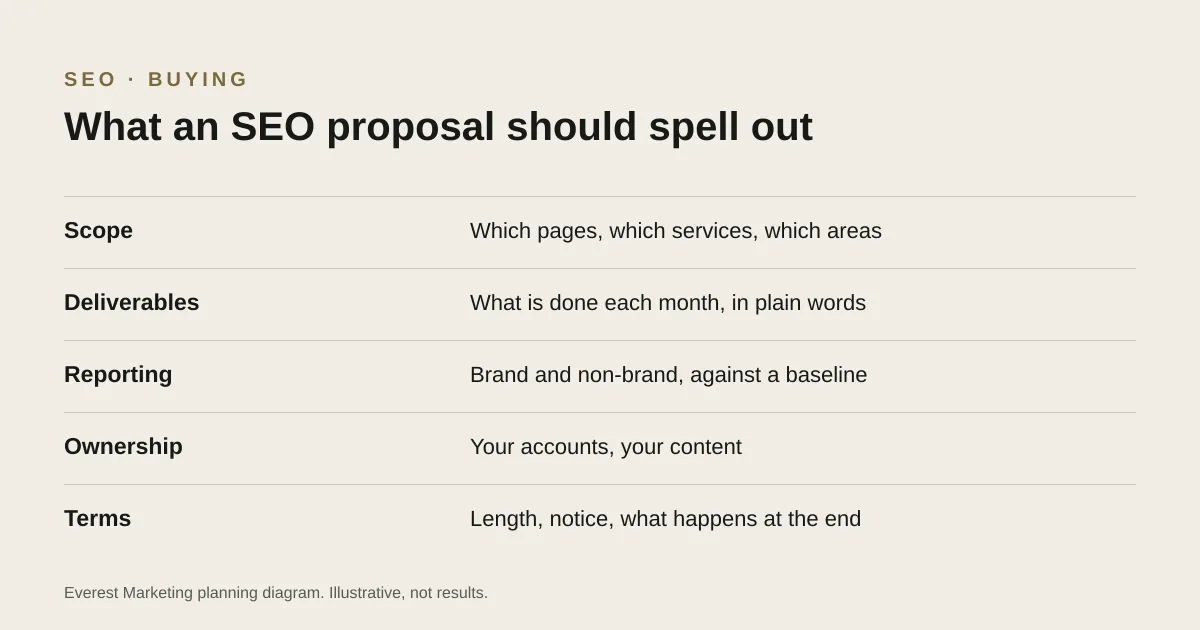
A useful SEO proposal says which pages, services and areas the work covers, what will actually be done each month in plain words, how results will be reported against a starting baseline, who owns the accounts and content, and the contract length and notice period. Google suggests asking any SEO for examples of past work, whether they follow Google Search Essentials, what results they expect and how they measure them, and how they will tell you about changes. Be wary of guaranteed rankings: Google says no one can guarantee a #1 ranking.
SEO packages are hard to compare because they describe different things with the same words. One “monthly SEO” plan is a report and a few blog posts; another is technical fixes, rewritten service pages and Business Profile work. This guide gives you the questions that make proposals comparable.
What a proposal should spell out
| Area | What good looks like | Ask if it is missing |
|---|---|---|
| Scope | The pages, services and areas covered | Which pages will you work on first, and why? |
| Starting point | A baseline from Search Console: queries, pages, clicks, impressions | What will you measure before changing anything? |
| Monthly work | Specific tasks in plain words, such as fixing indexing issues or rewriting a service page | What will you actually do in month one, two and three? |
| Content | Who writes it, who approves it, and that it is about services you really offer | Who writes, and can I see an example? |
| Reporting | Brand and non-brand results reported separately, against the baseline, plus enquiries where measurable | How will I know if it is working? |
| Ownership | Your Search Console, Analytics and Business Profile; content belongs to you | Whose accounts will you use? |
| Terms | Contract length, notice period, what happens at the end | Can I leave, and what do I keep? |
The questions Google suggests
Google’s “Do you need an SEO?” page lists questions to ask a potential SEO. Among them:
- Can you show me examples of your previous work and share some success stories?
- Do you follow Google Search Essentials?
- What kind of results do you expect to see, and in what timeframe? How do you measure your success?
- What is your experience in my industry, and in my country or city?
- How can I expect to communicate with you, and will you share all the changes you make to my site?
Warning signs
Google’s same page warns about several things worth taking seriously:
- Guaranteed rankings. Google says no one can guarantee a #1 ranking, and warns against SEOs who claim a “special relationship” with Google.
- Unsolicited emails from SEO firms you have never contacted.
- Link schemes, or submitting your site to thousands of search engines.
- Secrecy about what they will actually do.
Add two of our own: dozens of near-identical suburb pages, which Google’s spam policies describe as doorway abuse, and reports that only show total traffic without separating searches for your business name. Our guide to brand vs non-brand reporting explains why that split matters.
Comparing two proposals
- Do both cover the same pages, services and areas?
- Can you list what each will do in the first three months?
- Does each say how results will be measured, and against what baseline?
- Is the content written about services you really offer, by someone who has asked you about them?
- Who owns the accounts and the content if you stop?
- What is the minimum term and the notice period?
If a technical clean-up is part of the work, our guides to pages that are not indexed and internal linking show what that work involves.
Sources
- Do you need an SEO?Google Search Central, accessed 28 October 2026. Source for: no one can guarantee a #1 ranking; Google never accepts money to rank sites; advertising with Google does not affect organic results
- Spam policies for Google web search: doorway abuseGoogle Search Central, accessed 28 October 2026
- Introducing the branded queries filter in Search ConsoleGoogle Search Central Blog, 20 November 2025, updated 11 March 2026. AI-assisted classification that may misidentify some queries; top-level properties with enough data only