
SEO or Google Ads for a service business? A decision guide
Choose between SEO and Google Ads by timing, cash flow, capacity and the searches you want to win, with a decision worksheet and two worked examples.
Choose Google Ads when you need enquiries soon, can fund clicks every month and have the capacity to take the work. Choose SEO when you can wait for results, want visibility that does not stop when spending stops, and can keep improving your pages. Many service businesses use both: ads to cover the searches that matter now, and SEO for the pages that can earn visits over time. Google says advertising has no effect on organic results, so one does not buy the other.
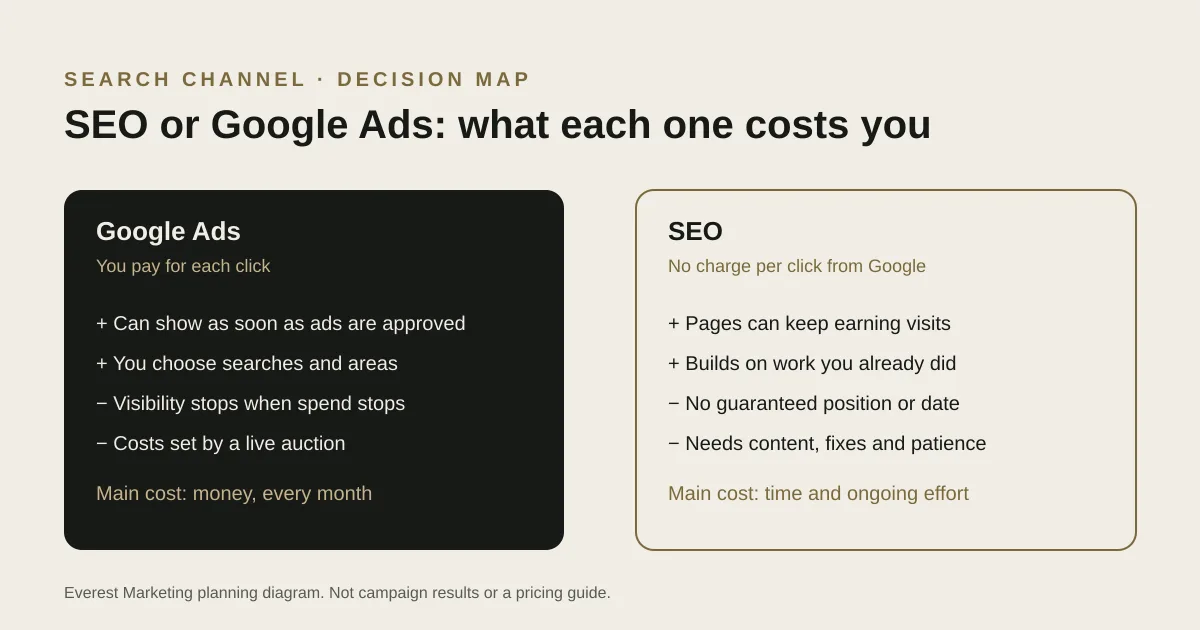
Both channels put you in front of people who are searching for what you do. The difference is what you pay with. Google Ads costs money for every click, and stops the moment you stop paying. SEO costs time and effort, and there is no promised date or position at the end of it. The right choice depends less on which channel is “better” and more on which of those costs your business can carry right now.
How each one works
Google Ads shows your ad for searches you choose, in the areas you choose. You are charged when someone clicks. The price of a click is set in a live auction: Google’s help pages explain that the actual cost per click depends on your bid, the quality of your ad and landing page, and how competitive the auction is, and is often less than your maximum bid. Our guide to Google Ads costs in Australia explains how to plan a budget around that.
SEO is the work of making your pages useful and easy for Google to understand, so they can appear in the unpaid results. Google does not charge for those results and, in its own words, “never accepts money to include or rank sites”. Google’s SEO Starter Guide also says changes take time to show: some within hours, others over several months. Nobody can guarantee a position; Google warns against anyone who claims to.
The comparison that matters
| Question | Google Ads | SEO |
|---|---|---|
| What you pay with | Money for each click, plus management if you outsource it | Time and effort: content, fixes, reviews, links |
| When it can start working | Once ads are approved and running | Uncertain. Google says some changes show in hours, others take months |
| What happens when you stop | Ads stop showing straight away | Pages can keep appearing, but rankings can slip without upkeep |
| Control over which searches | High: you choose keywords, areas and times | Indirect: you choose what to write about, Google decides where it ranks |
| Good for testing an offer | Yes, you can see search terms and enquiries quickly | Slow, because results take time to appear |
| Main risk | Paying for clicks that never become enquiries | Spending months on pages that never rank for the searches you need |
When Google Ads is the better first step
- You need enquiries in the next few weeks, not the next few months.
- People already search for your service in your area, and you can name those searches.
- You can afford a monthly media budget while you learn what works, separate from any management fee.
- Your team can respond to the extra enquiries, and your landing page and form have been tested.
- You want to test a new service or area before investing in pages for it.
When SEO is the better first step
- Cash is tight, but you or your team can put in time on pages, photos and reviews.
- Your website is thin or hard for Google to read, so ads would be sending people to a weak page anyway.
- You serve a defined area and can build genuinely useful pages for your main services.
- You are happy to wait and judge progress over months, not weeks.
For many local service businesses, part of the SEO work is not on the website at all: a complete, accurate Google Business Profile and a steady stream of genuine reviews. Our Google Business Profile basics and local SEO guide cover that side.
Using both without paying twice
The two channels work well together when they share what they learn. Google Ads shows many of the actual searches that triggered your ads, and with conversion tracking in place, which of them produced enquiries. That is useful evidence when deciding which service pages to build or improve for SEO. Pages built that way can then do double duty as landing pages for your ads.
- Run ads for the services you need booked now, and review the search terms report regularly.
- Use the searches that produce real enquiries to decide which pages to improve first.
- Measure both channels with the same definition of a useful enquiry, so the comparison is fair.
- Revisit the balance each quarter, rather than assuming either channel must run forever.
Two worked examples
Both are hypothetical, written to show the reasoning. They are not Everest client results.
An emergency plumber
Someone with a burst pipe wants help now, not a long read. If the plumber has the capacity to answer the phone, ads targeting urgent searches in the suburbs they actually cover can produce calls quickly. SEO still matters, especially the Google Business Profile, because searches like these can show local business listings. But for the next month of work, ads are likely to be the faster lever. The risk is paying for clicks from outside the service area, so location settings and search terms need regular checking.
A landscape designer
Someone planning a garden redesign researches for weeks, looks at portfolios and compares designers. The decision is slow and considered. A strong portfolio, project pages and useful guides can earn visits from that research over time. Ads can still help, but each click is paying for someone who may be months from deciding. Here SEO may be the better long-term investment, with a modest ad budget reserved for the highest-intent searches.
A decision worksheet
- How soon do you need new enquiries? Weeks points to ads; months gives SEO room to work.
- Can you fund a monthly media budget for at least a few months while you learn? If not, start with SEO and your Google Business Profile.
- Which three searches would you most like to appear for? Write them down.
- Do you already have a page that answers each of those searches well? If not, that is SEO work either way.
- Who answers new enquiries, and how quickly? Neither channel helps if leads wait.
- What counts as a useful enquiry? Agree it now so both channels are judged the same way.
How to judge whether it is working
For ads, compare spend against enquiries that were actually suitable, not clicks or forms. The qualified lead cost calculator does that arithmetic, and the advertising break-even calculator shows the most you could pay per enquiry before a job stops being worth winning. For SEO, watch Search Console impressions and clicks for the searches you care about, then the enquiries those pages produce. Give SEO longer before judging it, and judge both on booked work, not traffic.
If you would like help choosing, our Google Ads and SEO pages explain how Everest approaches each one.
Sources
- Do you need an SEO?Google Search Central, accessed 28 October 2026. Source for: no one can guarantee a #1 ranking; Google never accepts money to rank sites; advertising with Google does not affect organic results
- SEO Starter GuideGoogle Search Central, accessed 28 October 2026
- Actual cost-per-click (CPC)Google Ads Help, accessed 28 October 2026. Explains that the click price comes from the auction and Ad Rank, and is often below the maximum bid