
Ad creative brief template for Facebook and Instagram ads (free Word download)
A free ad creative brief template in Word for service businesses running Facebook and Instagram ads: the offer, next step, what to show and say, and testing.
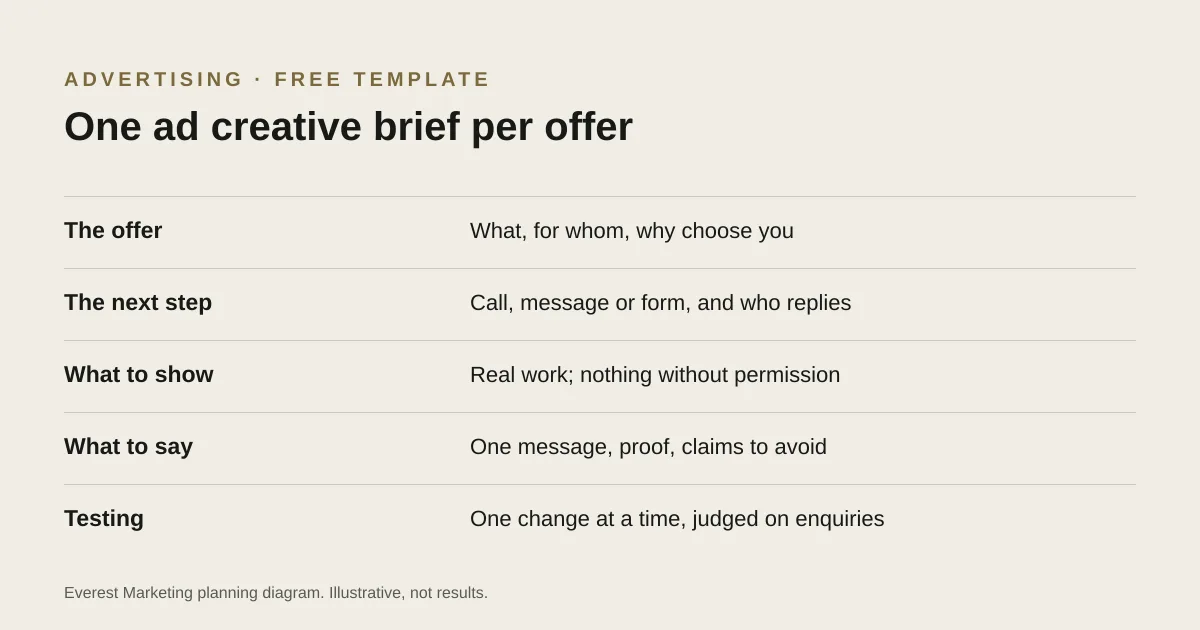
One brief per offer. It should state the offer and who it is for, why someone should choose you, the next step you want the viewer to take and what happens after they respond, the real photos or video available and anything that must not appear, the main message and proof you can back up, the formats needed, what you will test, what counts as a result, and who approves the final ads. Our free Word template has a section for each.
An ad usually involves several people: whoever takes the photos or video, whoever edits them, whoever writes the words and whoever sets up the campaign. Without a brief, each fills the gaps with their own assumptions. A one-page brief keeps them working from the same facts, and gives you something to check the finished ads against.
What goes in each section
1. The offer
One service or offer per brief. Say who it is for, including where they are and what situation they are in, and why they should choose you. Stick to reasons you can back up. Include how pricing works only if you are happy to show it publicly.
2. The next step
What the viewer should do: call, message, fill in a form or visit a page. Say where the click goes and who replies, and how quickly. If you are deciding between a Meta instant form and a landing page, our guide to instant forms vs landing pages covers the trade-offs, and our lead form questions guide covers what to ask.
3. What to show
List the real material you have: photos or video of your work, team, vehicles or premises. Then list what must not appear: customers’ faces or addresses without permission, competitors’ names, and anything that implies a claim you cannot prove. Note the formats needed, such as square, vertical for stories and reels, and video length.
4. What to say
One main message, in a sentence. The proof: reviews you have permission to quote, licence details if your trade requires them in advertising, and warranties. And the words to avoid, such as “cheapest” or “guaranteed”, unless you can prove them.
5. Testing and measurement
Decide what you will test, changing one thing at a time, such as the image, the headline or the offer, so you can tell what made the difference. Decide what counts as a result before the ads run: accepted enquiries, not likes or clicks. Our qualified lead cost calculator helps compare versions on cost per useful enquiry.
6. Approval
Who signs off the final ads, and by when. One person is usually enough.
Before the ads go live
- Does the ad match the offer and audience in the brief?
- Does every claim have proof you could show if asked?
- Does anything appear that was on the “must not appear” list?
- Does the click go where the brief says, and does someone know to reply?
- Is it clear which version is which, so the test can be read?
Sources
- Building trade advertisementsNSW Government (Fair Trading), accessed 28 October 2026. Licensee name and licence number in all advertising, including the internet. NSW only; other states have their own rules
- About lead ads with instant formsMeta Business Help Centre, accessed 28 October 2026. Help Centre wording and settings change; check the current page and Ads Manager before relying on any detail
- How to track Meta Ads leads from click to customerEverest Marketing