
Landing page or full website: what does your business need?
The difference between a landing page and a full website, when a service business needs each, what each typically costs in Australia, and a worksheet to decide.
A full website is your home base: every service, your proof, your story and how to contact you, and the place people check when they hear your name. A landing page is a single page built for one offer and one audience, usually for an ad campaign, with one next step. Many service businesses need the website first, then add landing pages when they advertise a specific offer. A landing page on its own can work for a short test, but it is a thin base to build a business on.
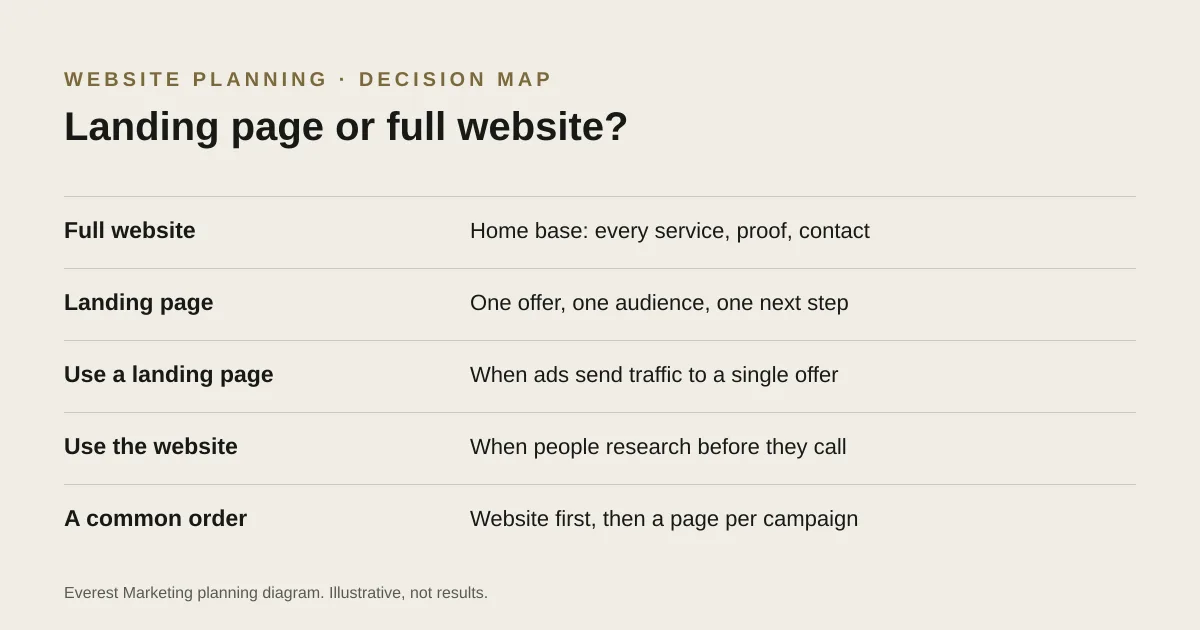
The two get confused because they can look alike: a landing page is often built with the same tools as a website, and a website’s service page can work as a landing page. The difference is what each is for.
The difference in one table
| Full website | Landing page | |
|---|---|---|
| Purpose | Represent the whole business | Convert visitors from one campaign or offer |
| Pages | Several: home, services, about, proof, contact | One, sometimes with a thank-you page |
| Who arrives | Anyone: search, referrals, people checking you out | Mostly people who clicked a specific ad or link |
| Navigation | Full menu, so people can explore | Minimal, so attention stays on one action |
| Search visibility | Can rank for many searches over time | Not usually built to rank; most visitors arrive from the ad or link |
| Typical Australian cost (third-party estimate) | About $2,000–$6,000 for a 5–10 page small business site; more for custom design | About $800–$3,000 |
The cost ranges come from an Australian price guide, What’s The Damage?, checked in October 2026. They are third-party estimates, not Everest’s prices, and the publisher also sells listings to web designers. Our website cost guide explains what moves the price.
When a landing page is the right call
- You are running ads for one specific offer, such as a seasonal service or a fixed-price package, and your website’s pages do not match the ad closely enough.
- You want to test an offer before building it into the main site.
- The campaign needs its own form or tracking, so its results are easy to separate.
- You already have a decent website and need a focused page for a campaign, not a new site.
If you are running Meta lead ads, the decision between an instant form and a landing page comes first; our guide to instant forms vs landing pages covers it.
When you need the full website
- People research before they call: they want to see your work, read about your process, and check you are real.
- You want to be found in unpaid search for several services or areas.
- Referrals and word of mouth send people to look you up by name.
- You offer several services, each needing its own explanation.
Often, a good service page on your website can do the landing page’s job too. If each service has its own page that matches what people search for, you may not need separate landing pages at all.
Two worked scenarios
Both are hypothetical, to show the reasoning.
A cleaner with no website
A new end-of-lease cleaning business wants to start running Facebook ads next week. A single landing page with the offer, the suburbs covered, real before-and-after photos and a short quote form can get the test running. But customers who search the business name later will find almost nothing, so the next step is a small website with a page per service.
A builder with an established site
A builder with a solid website wants to advertise granny flats specifically. Their site has a general “Services” page that mentions granny flats in one line. Rather than a separate landing page, they build a proper granny flat page on the main site: what is involved, approvals, timeframes, past projects. It works for the ads and can also be found in search.
Decision worksheet
- Do you have a website that represents the business well today? If not, start there.
- Is the campaign about one specific offer? If yes, check whether an existing page already matches it.
- Would a visitor from the ad find what the ad promised within a few seconds on that page?
- Do you need the campaign’s results kept separate from the rest of the site?
- Will this page still be useful after the campaign ends? If yes, build it into the website.
What every landing page needs
- A headline that repeats what the ad promised.
- Genuine proof: your own photos, reviews, and what is included.
- One clear next step, with the phone number for people who would rather call.
- A short form that has been tested end to end on a phone.
- Tracking that counts accepted enquiries, not button presses.
Sources
- Web design cost in AustraliaWhat’s The Damage? (Focus Search Pty Ltd), prices verified October 2026, accessed 25 October 2026. Third-party estimate. The publisher also sells listings to web design agencies
- Creating helpful, reliable, people-first contentGoogle Search Central, accessed 25 October 2026
- Forms tutorialW3C Web Accessibility Initiative