
How to follow up on a quote without nagging: checklist and message templates
A quote follow-up checklist for service businesses: when to check in, email and SMS wording to copy, handling common objections, and recording why quotes are lost.
Send the quote with what is included and how to accept it. Check in a day or two later to ask whether they have questions. Answer the real objection, usually timing, scope or price. Send one final note that leaves the door open, then close the quote and record the outcome and the reason. Keep each message short and personal, and follow the Spam Act rules on consent, identifying your business and unsubscribing.
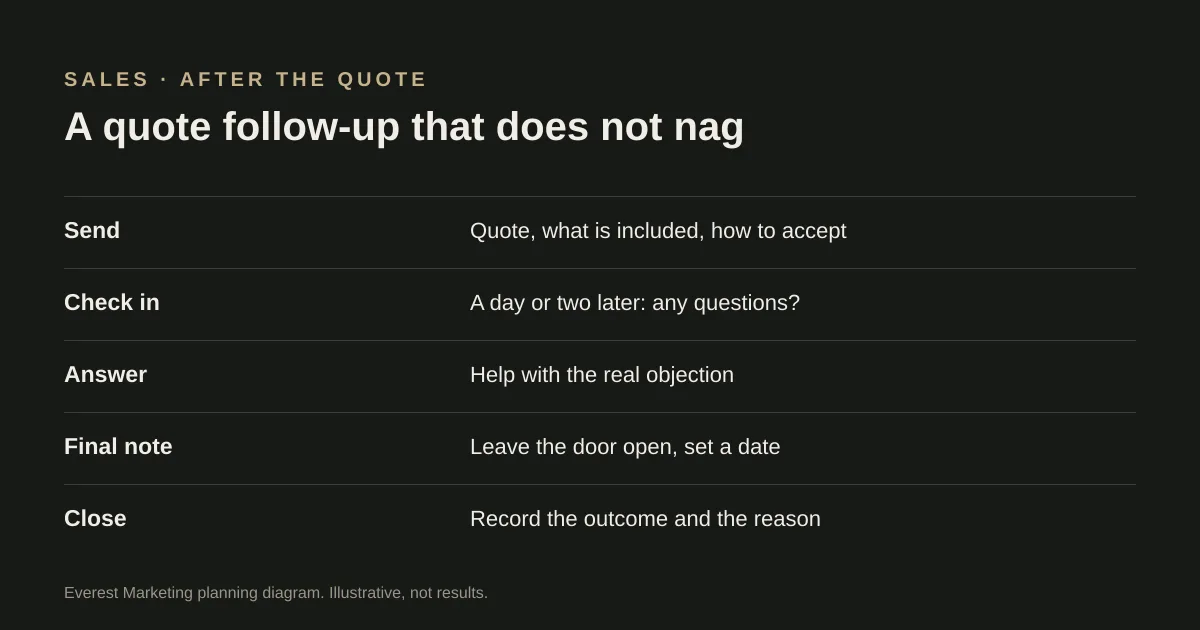
Getting the enquiry and sending the quote is the expensive part. Following up can feel pushy, or slip when the week gets busy. A short, planned sequence deals with both. It is not about pressure: someone who goes quiet may be busy, unsure or comparing, and a helpful check-in gives them an easy way to reply.
Send a quote that is easy to say yes to
- Restate the job in the customer’s words, so they know you understood.
- List what is included and what is not.
- Say how long the price is valid and when you could start.
- Make accepting easy: reply “yes”, sign online, or pay a deposit.
A simple follow-up sequence
| When | What to send | Purpose |
|---|---|---|
| Day 0 | The quote, with a short personal note | Make it clear and easy to accept |
| Day 1–3 | A short check-in | Catch questions early |
| Day 5–10 | An answer to whatever is holding them back | Help them decide |
| Day 10–20 | A final note that leaves the door open | End politely; free your time |
| After that | Mark the quote won or lost, with a reason | Learn what to change |
Message templates
Check-in (SMS)
Hi [first name], [your name] from [business] here. Just checking the quote for [job] came through okay. Happy to answer any questions or adjust anything. Thanks!
Answering a question (email)
Subject: Your quote for [job]. Hi [first name], you asked about [question]. [Plain answer.] If it helps, we could [option, such as staging the work or a different finish] which would change the price to [amount]. Let me know what suits. [your name]
Final note (email or SMS)
Hi [first name], I won’t keep chasing, but wanted to let you know the quote for [job] is valid until [date]. If the timing isn’t right, no problem. Just reply when you’re ready. [your name]
Handling the usual reasons
| What they say | What it often means | A helpful response |
|---|---|---|
| “We’re still deciding” | Comparing, or waiting on someone else | Offer to answer questions, or to talk to the other decision-maker |
| “It’s more than we expected” | Scope or value is unclear | Explain what drives the price, or offer a smaller first stage |
| “Not right now” | Timing | Ask when would suit, and agree a date to check back |
| No reply | Busy, or gone elsewhere | One more short message, then close it |
Stay on the right side of the Spam Act
Follow-up emails and texts that promote your services can count as commercial electronic messages under the Spam Act 2003. ACMA describes three rules for those: consent (express, or inferred, which ACMA says is less reliable), identifying your business, and a working way to unsubscribe that is honoured within five working days. The simplest habit is to include your business name and an easy way to opt out in every follow-up, and to stop when someone asks. This is general information, not legal advice.
Make it a routine
- Every quote has an owner and a next follow-up date.
- Templates are saved where the team can use them.
- Quotes older than your final-note date are marked won or lost.
- Lost quotes have a reason: price, timing, scope, chose someone else, no reply.
- Once a month, look at the reasons. If one keeps coming up, fix the quote or the offer.
A CRM can set the follow-up dates and send reminders for you; our guide to CRM automation for service businesses explains how. For what happens before the quote, see how to turn more enquiries into bookings.
Sources
- Avoid sending spamAustralian Communications and Media Authority, accessed 28 October 2026. Consent, identification and unsubscribe; unsubscribe requests honoured within 5 working days. ACMA’s site was unavailable to our checker on the day, so these points were confirmed from ACMA’s published guidance summaries; read the current page